
 4 months ago
230
4 months ago
230
A new rift forming beneath Zambia could eventually split the African continent apart, a new analysis of geothermal springs indicates.
The Kafue Rift is part of a 2,500km-long zone running from Tanzania in the east to Namibia in the west and likely as far as the mid-Atlantic ridge.
This rift could become a new tectonic plate boundary and lead to the break-up of sub-Saharan Africa, researchers from Oxford University say.
“The hot springs along the Kafue Rift of Zambia have helium signatures which indicate that the springs have a direct connection with the mantle, which lies between 40 and 160km below the Earth’s surface,” Mike Daly, an author of a new study published in the journal Frontiers in Earth Science, explained.
“This fluid connection is evidence the fault boundary of the Kafue Rift is active and therefore the Southwest African Rift Zone is too and may be an early indication of the break-up of sub-Saharan Africa.”
Researchers first suspected this was happening when they found high levels of geothermal anomalies, including the formation of hot springs, around the rift zone.
“A rift is a large break in the Earth’s crust that creates subsidence and associated elastic uplift,” Dr Daly explained. “A rift may become a plate boundary but commonly a rift’s activity ceases before the point of plate boundary formation.”
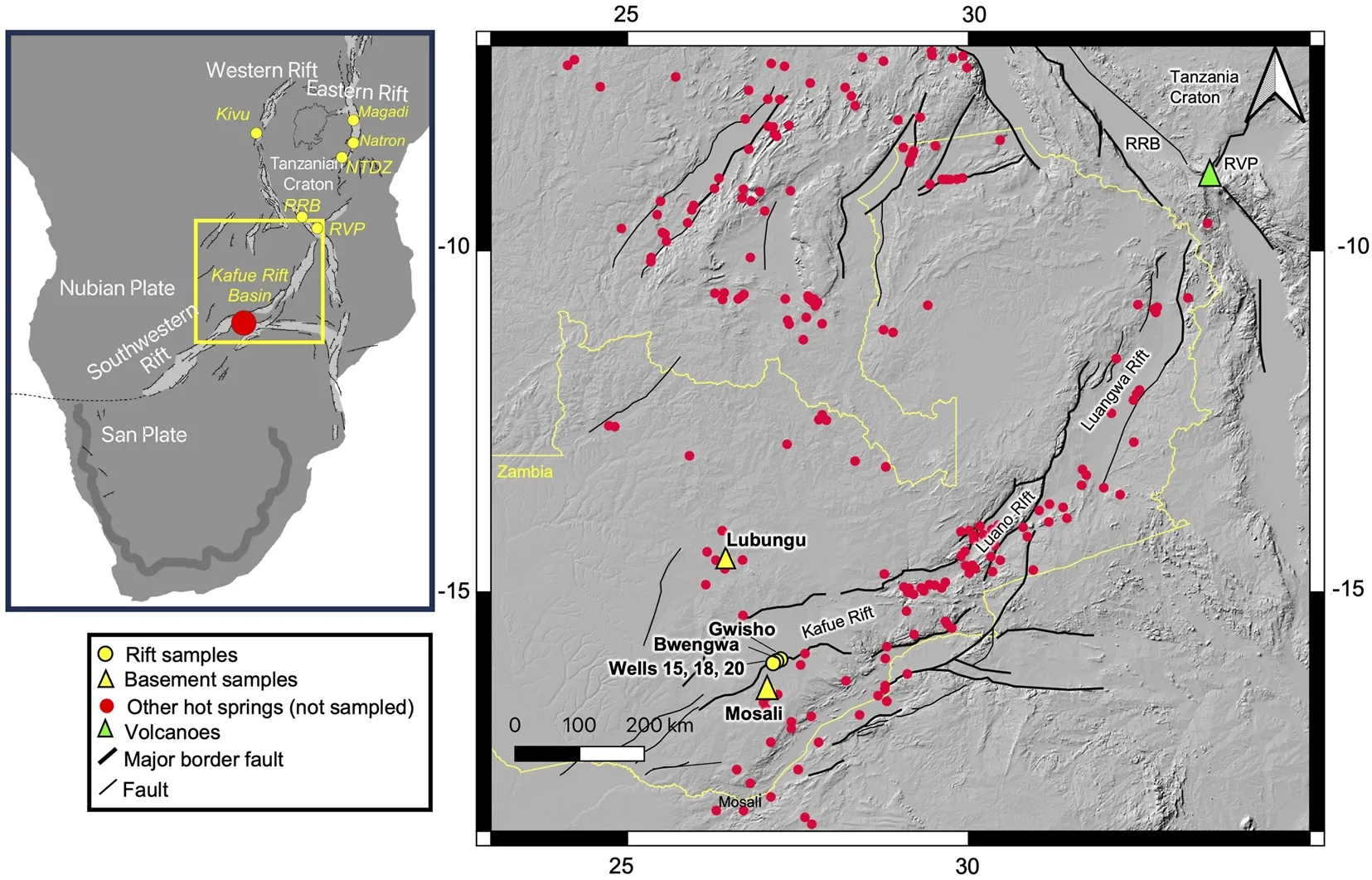
Researchers visited eight geothermal wells and springs in Zambia and took samples of gas from freely bubbling water.
When they tested the chemicals present in the samples, they detected gas derived from mantle fluids at the surface.
They found that gas from the Kafue Rift contained a form of the element helium which could not have come from the atmosphere. The gas samples also contained a proportion of carbon dioxide consistent with the composition of mantle fluids.
All this points to an early stage of the rift breaking through the Earth’s crust.
“Many of the features of the Great Rift Valley of Kenya offer compelling reasons why East Africa should ultimately become a line of major continental break-up,” Dr Daly said.
“This early study is being followed by more extensive studies, the next step of which will be completed this year.”
The findings could bear important economic implications.
Such rift breaks provide geothermal energy and access to vast helium and hydrogen reserves that could reshape the economic future of Africa.












 English (US) ·