
 8 months ago
200
8 months ago
200
It seems that every year brings news of an even darker turn in society. It also seems that we have been saying so for a very long time.
In 1990, Richard Ganz and William Edgar wondered, “Who, back in 1960, would have believed that the press would one day pillory mothers and exalt abortionists?”
Back in 1941, however, Johannes Vos was writing that religious liberalism had already infected most of American Protestantism. The period since the First World War, he explained, had been characterized by “gradual doctrinal decline and disintegration.” (“Retrenchment in Covenanter Foreign Missions—What is the Remedy?” The Covenanter Witness 27, no. 17, p. 313).
The darkness of our present age cannot be divorced from that long trajectory. Nevertheless, the fact that America (and my own country, Canada) has progressively turned its back on Christ should not dampen our hopes for the future in 2026. A little more than two centuries ago, the spiritual state of England was exceedingly low. In 1797, William Wilberforce, an evangelical member of parliament, wrote that “the bulk of professed Christians” in his country were really Christians in name alone. Having adopted a small view of sin, they cared little for Christ and less for the Bible. On the contrary, said Wilberforce, “they advance principles and maintain opinions altogether opposite to the genius and character of Christianity.”
Darkness Defeated
The restoration of real Christianity in England was one of the two great objects to which Wilberforce believed God had called him. He bent much of his prodigious energy toward that end, and the plaque outside his birthplace is a fitting testament to his success: “England owes to him the reformation of manners.”
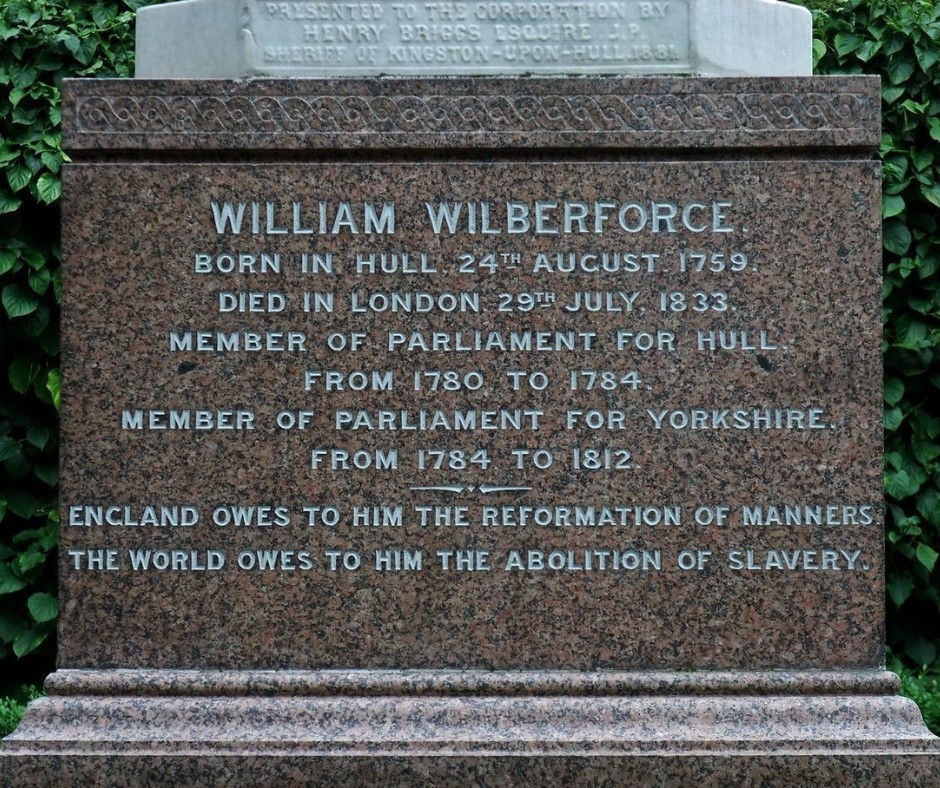 Image Credit: High Street, Kingston upon Hull by Bernard Sharp (CC BY-SA 2.0).
The second great object to which Wilberforce believed himself called, and the one for which he remains best known, was the abolition of the British slave trade.
He led the campaign for abolition in parliament over twenty years, facing ridicule, death threats, and assassination attempts along the way.
Certainly, to all appearances, the trade was an insurmountable obstacle. Powerful figures had a financial interest in it. Some argued that the empire would collapse in its absence. Meanwhile, the radical liberalism that birthed the French Revolution (1787-1799) gave serious pause to those who might otherwise have given Wilberforce their support.
In short, the situation was as complicated — and apparently hopeless — as any into which we might wade today. Yet the bill for abolition passed on 25 March 1807, and Britain ended its involvement in the trade.
The More Just Reflection
Many offered praise for Wilberforce when abolition finally became a reality. Among them was James Mackintosh, a Scottish jurist and politician, who wrote the following:
Who knows whether the greater part of the benefit he has conferred on the world… may not be the encouraging example that the exertions of virtue may be crowned by such splendid success?
We are apt petulantly to express our wonder that so much exertion should be necessary to suppress such flagrant injustice. The more just reflection will be, that a short period of the short life of one man is, well and wisely directed, sufficient to remedy the miseries of millions for ages.
Ah, brothers and sisters, we have no shortage of battles before us in 2026. Society grows ever more twisted without Christ, the church suffers assault from a tide of liberalism and godless philosophy, and the daily glories of family and work continue to present challenges of their own.
But how criminal it would be to think on these things and despair!
To paraphrase Mackintosh, the more just reflection is that one life, well and wisely directed, can be blessed by God to accomplish what seems impossible today. For his part, Wilberforce dismissed the praise he received, giving thanks rather to God for the change that had come over Britain:
I really cannot account for the fervour which happily has taken the place of that fastidious, well-bred lukewarmness which used to display itself on this subject, except by supposing it to be produced by that almighty power which can influence at will the judgment and affections of men.
There is no reason why God cannot likewise change the people of America and Canada.
Perhaps He will not do it this year. Perhaps, as in so many examples that we could take from Scripture, it will take decades. But in Scripture, too, God showed His strength to those who faced the darkness and trusted Him.
So, take heart, my brother, my sister!
And may God crown your every work of faith with success.








 English (US) ·