
 3 months ago
297
3 months ago
297
State agriculture officials are deploying thousands of parasitic wasps across Hawaii to combat rising infestations of the invasive stinging nettle caterpillar, a pest known for its painful sting and destructive effect on tropical foliage.
The Hawaii Department of Agriculture and Biosecurity team reports a recent surge in sightings, particularly in windward Oahu and parts of Maui, according to Hawaii News Now.
Originally native to Southeast Asia, the nettle caterpillar was first detected on the Big Island in 2001, likely introduced through a shipment of rhapsis palm seedlings from Taiwan, according to the Hawaii Invasive Species Council. It has since established populations across all major Hawaiian islands.
The insects pose a severe threat to local nurseries and property owners because they feed on a wide variety of host plants, including ti leaves, areca palms, coconut trees and banana plants.
“I think it’s definitely gonna be an issue for people like me who wanna do cut flower business,” Maui resident Hailey Ramos told Hawaii News Now.
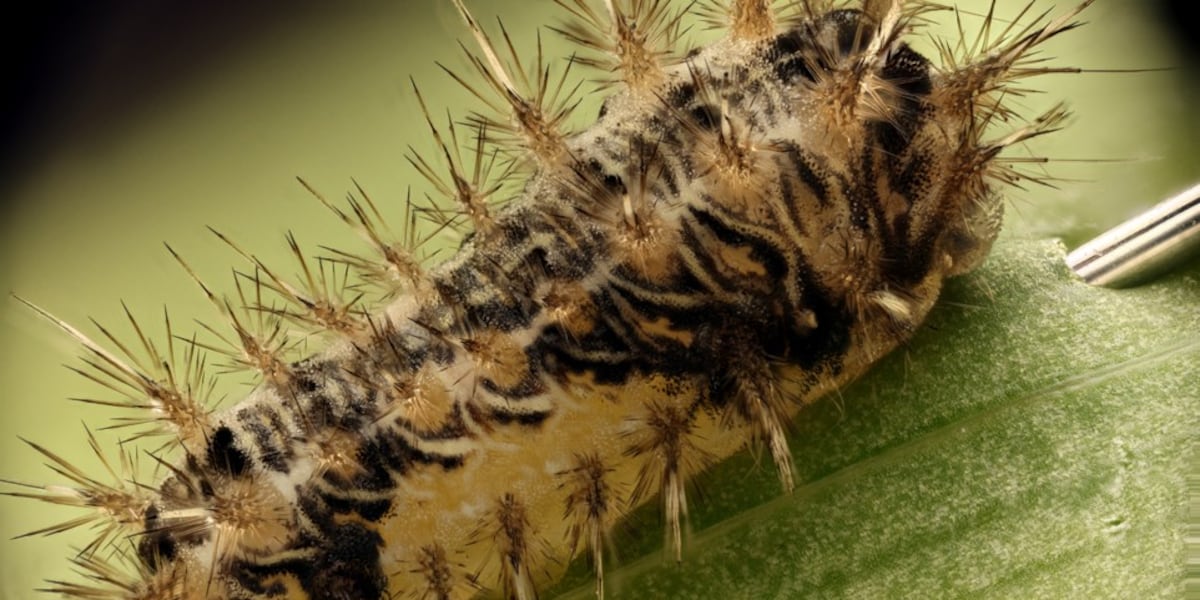
Ramos, who lives in Haiku, said she had found roughly a dozen of the pests on her property over the last six months.
“I’ve been trying to take it very seriously and making sure that I notice the signs of the missing chunks of the leaves and taking care of that,” Ramos said, adding that the caterpillars are quite small. “They’re probably maybe about not even the tip of my finger, and they’re very thin, like thinner than a pencil.”
The larval form of an Asian moth, the caterpillars are covered in rows of venomous spines that release an irritant upon contact. According to the Hawaii Invasive Species Council, the population typically peaks during the summer months.
“They have tiny stinging hairs, similar to fiberglass, and they release an irritant which is a mixture of histamines produced by a poison gland,” Reina Tong, an entomologist with the Department of Agriculture, told Hawaii News Now.
The sting causes a burning, itching sensation, swelling and welts that can persist for days, often followed by a rash lasting several weeks. Health officials advise people who are stung to monitor their symptoms and seek medical attention if they experience severe allergic reactions.

To manage the outbreak, state technicians are using biological control methods first introduced by state and federal agriculture authorities in 2010. They are conducting controlled releases of a specific parasitoid wasp from Taiwan that acts as a natural predator to the caterpillars but does not sting humans.
Over the last four months, 10 communities have requested assistance from the state for biological control interventions.
“Our technician releases about 150 wasps per site in an area,” Tong said. “She has released in the last four months about 1,500 of these.”
Despite these efforts, residents remain concerned about community-wide management.
“I’ve been trying my best on the ground, but it’s kind of a concern because people who don’t really check their plants often are possibly a breeding ground,” Ramos said.
Though the species is officially classified as a widespread pest for control under Hawaii administrative rules, the Hawaii Invasive Species Council states that it is “not part of a current control effort” due to its broad distribution.
However, officials still urge residents to inspect their plants and report new sightings to the Department of Agriculture’s 643-PEST hotline.












 English (US) ·